
Flux vs Ideogram: Which Is Better in 2026?
Flux and Ideogram are the two image models specialists reach for when the famous names are not quite right. Flux, from Black Forest Labs, is the photorealism and open-model choice: images that can pass for photographs, bought per image or run yourself. Ideogram is the typography specialist: the one model creators trust when the image itself must contain readable words. This fair comparison looks at what each tool actually does, what it costs in October 2026, and who each one suits best. Prices move fast in image generation — always verify the live pricing page before you buy.
Disclosure: This comparison contains no affiliate links. It is an independent editorial comparison based on public pricing and feature pages checked on 31 October 2026.
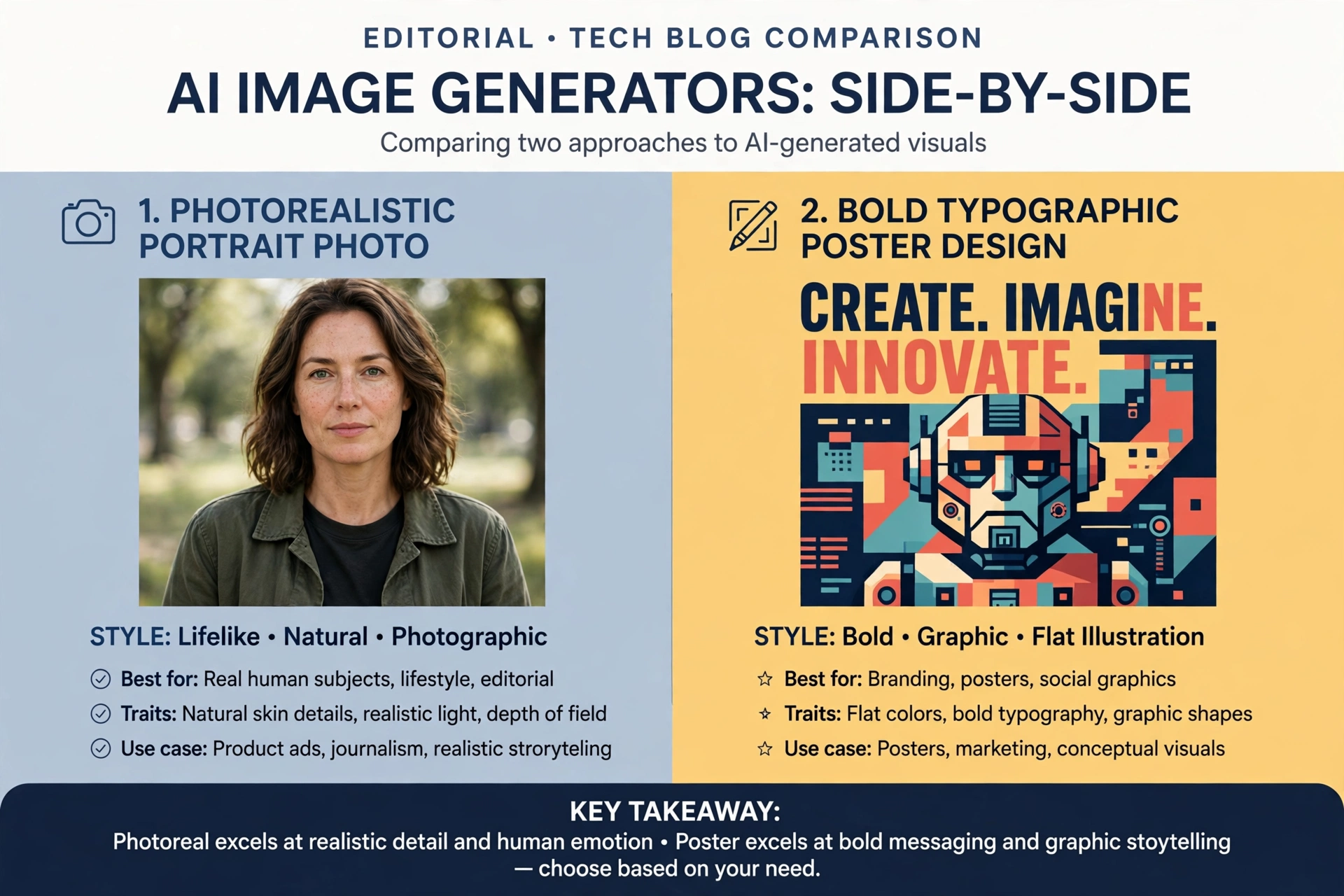
What Each Tool Does
Flux is a family of image models from Black Forest Labs, available through API partners and playgrounds, and as open weights you can self-host. Its reputation rests on photorealism — natural skin, realistic light, believable product shots — and strong prompt adherence, at a per-image price rather than a monthly subscription.
Ideogram is a standalone image platform built around one superpower: rendering text correctly inside images. Logos, posters, thumbnails, social graphics, and ads with headlines come out with words spelled right, in styles you can direct — where most general models still garble a word or two at exactly the wrong moment.
Side-by-Side Comparison
| Feature | Flux | Ideogram |
|---|---|---|
| Core strength | Photorealism and prompt adherence | Text rendering inside images |
| Best for | Product photos, portraits, realistic scenes, API products | Posters, logos, thumbnails, ads, social graphics with text |
| How you buy it | Per image via API partners, or self-host open weights | Subscription on ideogram.ai, with a limited free tier |
| Typical per-image cost | Roughly $0.03–$0.06 per standard image via API | Credit-based; Plus around $20/month in most listings |
| Free option | Open weights free to self-host; playgrounds rate-limited | Yes, limited slow credits per week |
| Paid tiers (Oct 2026) | No subscription required via API; partner pricing varies | From around $7/month in some listings; Plus ~$20, Pro ~$60/month |
| Text accuracy | Strong and improving, but not the specialist | Best in class — the reason to choose it |
| Photorealism | Best in class among open models | Good, but trails Flux on the hardest portrait and product shots |
| Editing | Varies by partner app; strong inpainting via API | Built-in editing, upscaling, and canvas tools |
| Commercial use | Yes, subject to the licence of the model and partner used | Yes, including on the free tier per vendor listings; paid plans add priority |
| Ease of use | Best via a partner app; raw API needs developer setup | Simple web app; type, generate, refine |
| Weakness to know | No single official consumer app; experience varies by partner | Priority credits expire monthly; photorealism is not its lead skill |

Flux: Strengths and Limits
Pros: if the job is “make this look like a real photograph”, Flux is the strongest answer that is not locked behind a big subscription. Per-image pricing means a creator who needs 50 product shots pays for 50 images, not a $30–$60 month, and developers can build it into products through APIs or self-host the open weights.
Cons: there is no one Flux app to recommend. Your experience — editor, pricing, limits — depends on which API partner or playground you use, and that fragmentation confuses beginners. If you want a polished consumer product with support and a simple editor, Flux alone is not that.
Ideogram: Strengths and Limits
Pros: the text argument is decisive. For thumbnails, posters, and ads, one misspelled headline ruins an otherwise perfect image, and Ideogram is the model creators trust to get the words right. The free tier is genuinely usable for testing, and commercial use is allowed even there according to vendor listings.
Cons: it is a specialist, and specialists lose outside their specialism. On pure photorealism — skin texture, product detail, hard portrait light — Flux and the top general models edge it out. Priority credits also expire monthly, so casual users should check how credits roll over before paying for a bigger plan.
Who Should Choose Which?
Choose Flux if your images must look real — product photography, realistic portraits, scenes for ads or listings — or you are a developer who wants per-image pricing or open weights without a subscription.
Choose Ideogram if your images contain words: YouTube thumbnails, posters, logos, social graphics, or ad creatives where a readable headline is the whole point. For that job, no photorealism advantage compensates for garbled text.
Plenty of creators use both in one workflow: Ideogram for the text-bearing graphic, Flux for the photographic asset inside it or beside it. If you buy one, buy the one that fixes the failure you actually hit most — unreadable text, or unconvincing realism.

FAQ
Is Flux free?
The open weights are free to self-host if you have the hardware; hosted use through API partners is pay-per-image, roughly $0.03–$0.06 per standard image. Community playgrounds offer limited free generations.
Is Ideogram really better at text than other generators?
Yes, by consensus across October 2026 comparisons: it is the only major model routinely trusted with long strings, multi-line layouts, and typographic styling. Newer general models are closing the gap, but Ideogram still leads.
Can I use both commercially?
Yes, subject to licences: Ideogram allows commercial use including on its free tier per vendor listings, and Flux images are commercial subject to the model licence and partner terms you use.
Which one should a YouTuber pick?
Ideogram, for thumbnails with text. A thumbnail lives or dies on its headline — that is Ideogram’s exact job.
Which one should a store owner pick?
Flux, for product photography that looks real. Shoppers trust photos that look photographed, and Flux is built for that.
Final Verdict
Choose Flux if photorealism or developer-friendly per-image pricing is your priority, and you are comfortable picking a partner app or API. Choose Ideogram if your images carry text and that text must be right, from thumbnails to posters. They are specialists, not rivals for the same job — the right pick is the one whose specialism matches your most common image. Rating: Flux 4.3/5, Ideogram 4.3/5.
More fair comparisons: our Midjourney vs DALL-E comparison, Jasper vs Writesonic, Surfer SEO vs Clearscope, and our best AI video generators guide.