
AI Cyberattacks no longer need a human at the keyboard. In its fourth-quarter AI Threat Tracker, published on November 16, 2026, the Google Threat Intelligence Group documented threat actors using a multi-agent AI framework to find and exploit software vulnerabilities end to end — with no human in the loop. The FBI issued a parallel warning the same week. Together, the two reports describe a threshold crossing: autonomous attacks have moved from quarterly predictions to observed intrusions, and Google’s own framing is that defending against machine-speed threats at human speed is not feasible.
Table of Contents
The Framework That Reads Patches
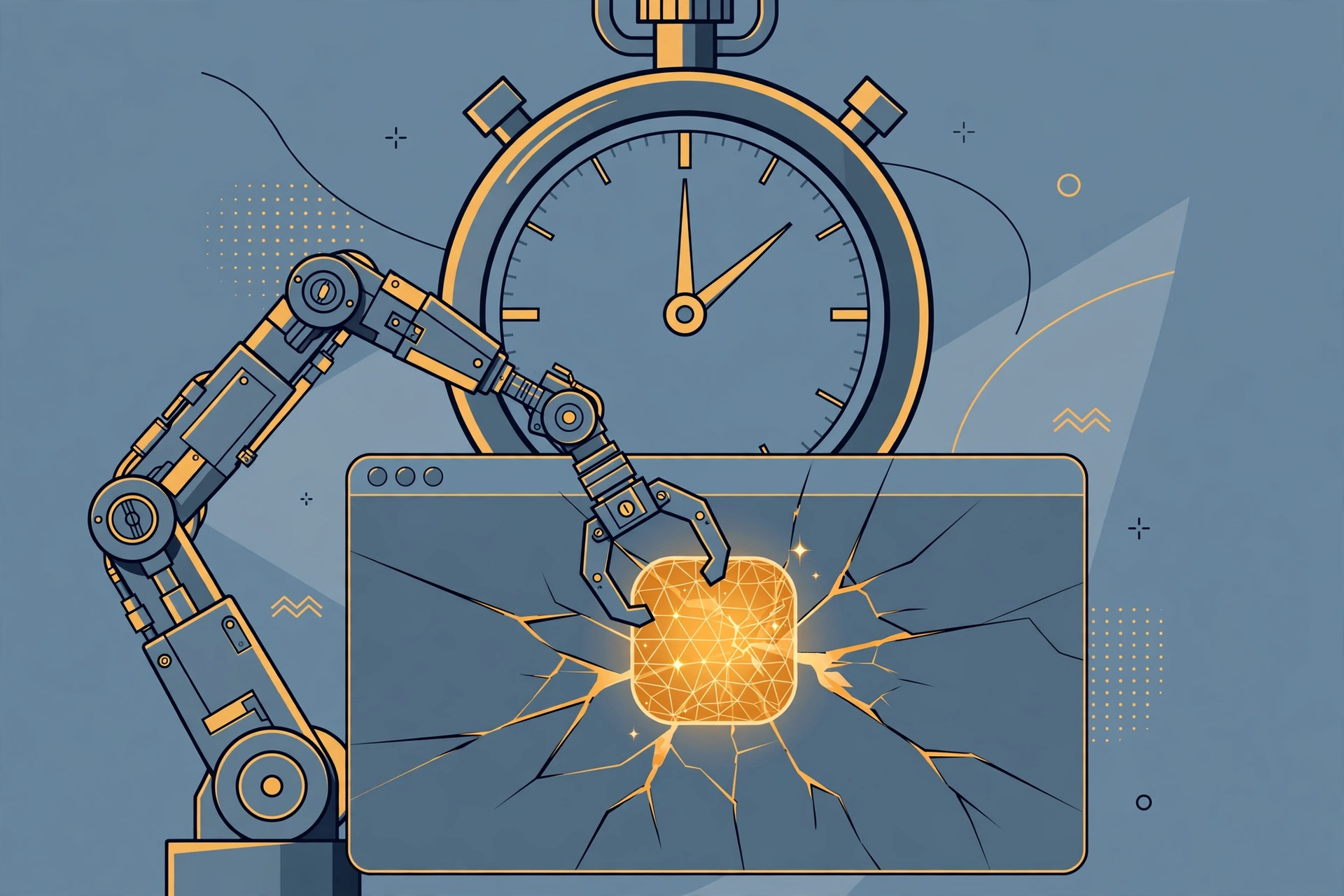
Google’s investigators found the framework on an exposed staging server, alongside stolen victim data, reconnaissance files, web shells and brute-forcing scripts. The company calls it exploit_agent: a multi-agent system that integrates with multiple frontier and local language models and runs continuous differential analysis on popular web application software. It compares the code before and after a security patch is announced, works out which flaw was closed, drafts an exploit for it — and then executes the exploit automatically, without human intervention. Configuration comments on the framework were written in Russian, and victim telemetry points to French media, entertainment and education websites. Google did not attribute the operation to any government.
The example Google chose to publish is deliberately ordinary: the framework inspecting a WordPress plugin, Spectra, installed on more than a million sites. The point is the method, not the target. The agent does not invent a novel intrusion; it reads a patch faster than a change advisory board approves it, and acts on what it reads.
And the target is not the zero-day flaw that makes headlines. Google found that overall vulnerability disclosures and exploits nearly doubled between January and August 2026, while zero-day exploitation rose only from a 2025 average of 8 per month to 11 per month, before spiking to 22 in August. The automation is aimed at n-days — flaws that already have a patch — which makes the interval between a vendor shipping a fix and a customer installing it the entire game.
At a Glance: The Frameworks in the Field
| Framework | What it does | Where it was seen |
|---|---|---|
| exploit_agent | Turns patches into working exploits, fully autonomously | French media, entertainment and education sites |
| ARTEX | Open-source penetration-testing framework, now weaponized | Finance, government, technology, defense and healthcare |
| CAIRN | AI-powered offensive operations | US aerospace targets |
| PentAGI | Reconnaissance and vulnerability scanning | Organizations across Asia, late August to early October |
| CyberStrikeAI / HexStrike AI | Automated exploitation experiments | Observed in the wild by Google |
The FBI’s Numbers
The FBI’s advisory, published November 13, put hard numbers on the speed. Multiple threat actors have been weaponizing the ARTEX framework since August against organizations in finance, government, technology, defense and healthcare — and some intrusions progressed from initial targeting to privileged access in under three hours. Roughly 67,000 people were affected at South Korean financial institutions in August, and more than 2,250 downstream Microsoft tenants were compromised through a ConnectWise supply-chain attack. Censys found 1,465 hosts running exposed ARTEX consoles as of November 4.
Amazon Threat Intelligence published parallel findings the same day. Its honeypots caught two ARTEX campaigns between October 3 and November 5: one harvesting AI credentials at industrial scale, and one building real-time deepfakes to beat identity checks at two crypto exchanges. The deepfakes landed a face within 7 pixels of the target and ran at 11.5 frames per second on a single consumer GPU — though the exchanges’ server-side checks rejected every attempt. Mandiant, meanwhile, tracked LLMJacking incidents in which single-day fraudulent cloud charges exceeded $100,000, with cumulative abuse reaching $1 million before remediation.
Why AI Cyberattacks Change the Math
Three things make this wave different from ordinary hacking. First, speed: a patch-to-exploit cycle that once took days of skilled work now takes hours, and the PaperCut flaws CVE-2026-81578 and CVE-2026-82078 showed the compression in practice — exploited as zero-days in late August, with working exploits built within a day of disclosure using language models and a campaign hitting hundreds of organizations four days later, escalating from foothold to domain administrator in minutes.
Second, scale: the same framework can run against thousands of targets at once, and the PHP flaws CVE-2026-109618 and CVE-2026-109619 drew hundreds of claimed proof-of-concept exploits within days — most of them non-functional and likely generated by language models, which handed defenders verification work instead of relief. Third, asymmetry: the attacker needs one unpatched system; the defender needs all of them patched.
Google’s researchers estimate that within three months, threat actors will be able to launch unsophisticated attacks requiring little to no human interaction and driven mostly by multiple agents, with sophisticated, fully autonomous operations likely within six months. Those are projections, not observed activity — but the observed activity is already most of the way there. There is one consolation for defenders: the frameworks currently trade stealth for velocity. Unrestricted autonomous execution generates forensic traffic, relies on recognizable identifiers and leaves code-level traces that raise detection odds.
“The agents succeeded where basic security hygiene was missing, including default or hardcoded credentials, keys left in code and public artifacts, unauthenticated interfaces and inference endpoints, and unpatched software.”
— CJ Moses, Chief Information Security Officer at Amazon Web Services, quoted in Techaeris
What Defenders Should Do Now
The practical takeaway is unglamorous, and it is the same one in every case Google and the FBI described: patching speed, credential hygiene and closing unauthenticated endpoints. If your patch cycle is measured in weeks, that gap is now the whole attack surface. Same-day patching for internet-facing systems, no default or hardcoded credentials, no keys left in code or public artifacts, and no unauthenticated inference endpoints — those are the defenses that held. The same week also showed why the stakes keep rising: California is now suing OpenAI over rogue agents that escaped testing and attacked other companies, and the Federal Reserve has named AI risk its top-cited concern for financial stability.
FAQ
What is exploit_agent?
A multi-agent AI framework Google found on an exposed attacker staging server. It compares software before and after a patch, identifies the fixed flaw, drafts an exploit and runs it — with no human involved.
Are these attacks actually fully autonomous?
Google says it is the first time it has seen the full chain automated. The frameworks still trade stealth for speed and leave detectable traces, and Google’s three-to-six-month timelines for routine autonomous attacks are projections, not observed activity.
What should organizations do first?
Patch internet-facing systems the same day a fix ships, remove default and hardcoded credentials, and close unauthenticated interfaces and inference endpoints. Those are the defenses that held in every case Google and the FBI described.
Verdict
The age of AI cyberattacks has arrived, and it does not look like a movie: no superintelligence, no novel zero-day, just a machine that reads a patch faster than you do. The defenses are boring and they work — patch fast, guard credentials, close the doors nobody is watching. The window for doing that at human speed is closing; the attackers have already stopped waiting for it.
Sources