GEO Optimizer Review – For years, search engine optimization revolved around one central goal: ranking on Google Search. You optimized keywords, built backlinks, improved technical SEO, and hoped to land on page one. But in 2026, that playbook is starting to feel… outdated. More users are skipping traditional search results altogether and heading straight to AI-powered platforms like ChatGPT and Perplexity AI. Instead of browsing links, they ask questions, and receive direct, curated answers.
This shift introduces a new challenge that many site owners haven’t fully grasped yet: your content doesn’t just need to rank anymore, it needs to be selected.
That’s where GEO Optimizer enters the conversation.
Positioned as a tool for “AI visibility,” GEO Optimizer promises to help your content get recommended inside AI-generated answers. It’s a bold claim, and one that taps into a very real change in how traffic works today.
But does it actually deliver meaningful value, or is it just another cleverly marketed SEO product?
Let’s take a closer look.
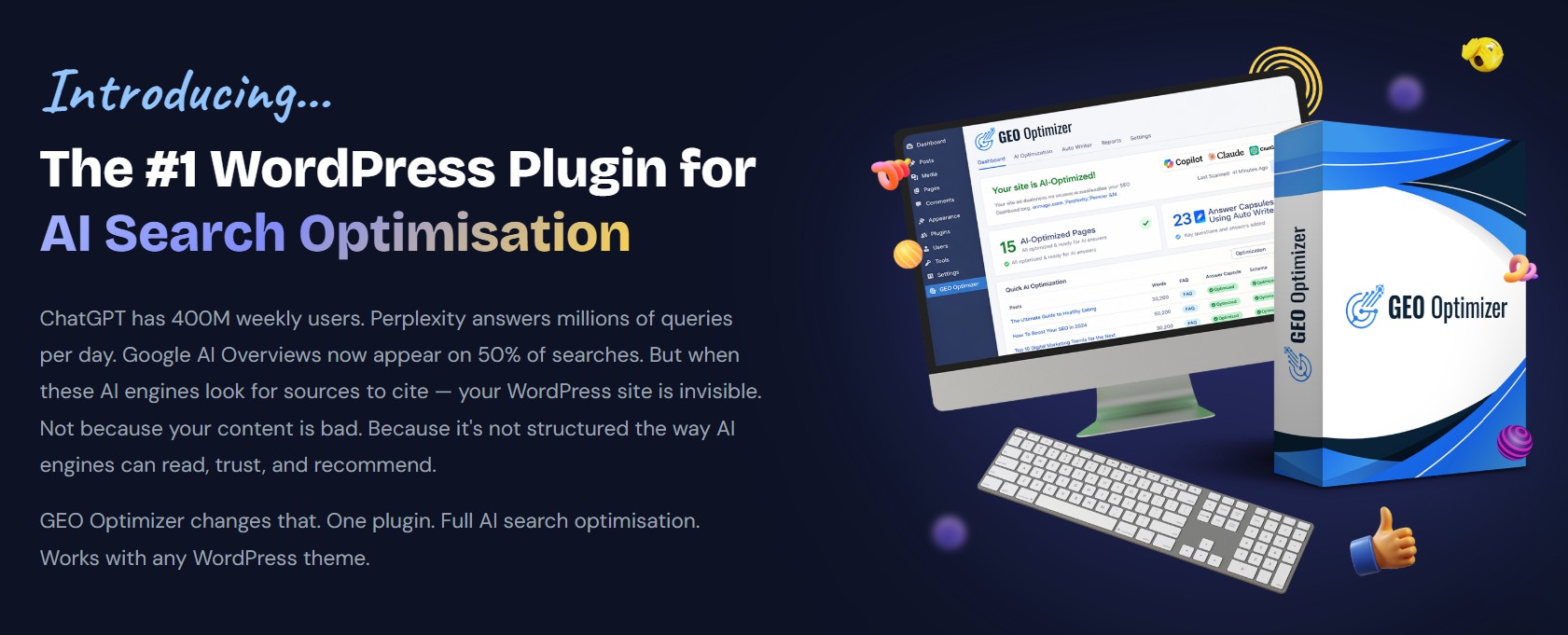

Table of Contents
What GEO Optimizer Actually Does
At its core, GEO Optimizer is designed to bridge the gap between traditional SEO and what’s now being called AI search optimization.
Instead of focusing purely on ranking signals like backlinks or keyword density, the tool emphasizes how content is structured, interpreted, and selected by AI systems.
This distinction is important.
AI tools don’t operate like search engines. They don’t simply crawl and index pages, then rank them based on authority signals. Instead, they extract, summarize, and recommend content they consider trustworthy and relevant.
In other words, they behave less like a directory and more like an editor.
GEO Optimizer attempts to align your content with that behavior. According to its positioning, it analyzes your existing pages and restructures them in a way that makes them easier for AI systems to understand and use as a source.
The promise isn’t just better rankings, it’s inclusion inside AI-generated answers.
GEO Optimizer Pricing & Funnel Breakdown (2026): Which Plan Is Actually Worth It?
Understanding the pricing structure of GEO Optimizer isn’t just about numbers—it’s about knowing which level matches your strategy in the era of AI-driven search.
Unlike typical WordPress plugins, GEO Optimizer is positioned as a Generative Engine Optimization (GEO) system, designed to help your content get discovered inside platforms like ChatGPT and Google AI Overviews.
Below is a complete, transparent breakdown of the funnel—along with practical insights on who each tier is really for.
Frontend: GEO Optimizer (Core Plugin)
The frontend offer is where everything starts. This is the core WordPress plugin that introduces your site to AI-ready optimization.
Priced between $37 (Starter) and $47 (Pro) as a one-time payment, it’s positioned as an accessible entry point for site owners who want to adapt quickly to the AI search shift.
At its core, GEO Optimizer focuses on making your content easier for AI systems to understand, extract, and recommend. It does this by automating several technical and structural elements that are often overlooked in traditional SEO workflows.
One of its standout features is the AI-Ready Writer, which helps generate structured components such as FAQs, answer-focused sections, and JSON-LD schema. These elements are particularly important because AI systems tend to favor content that is clearly organized and directly answers user queries.
In addition, the plugin includes automated optimization for key technical files like sitemap.xml and robots.txt, along with an llms.txt generator, which is increasingly relevant for guiding AI crawlers.
The built-in GEO visibility score dashboard provides users with a simplified way to measure how “AI-friendly” their content is—although, like most scoring systems, it should be used as a guideline rather than an absolute metric.
From a usability standpoint, the plugin works across any WordPress theme, making it accessible even for non-technical users.
The difference between the two plans is straightforward:
- Starter allows optimization for up to 5 sites
- Pro removes that limitation with unlimited sites
For most serious users, the Pro version offers significantly better long-term value.
OTO 1: GEO Optimizer AutoPilot
The first upsell introduces automation, and this is where the product starts to feel more like a system rather than a simple plugin.
At a one-time price of $67, AutoPilot is designed to eliminate the need for ongoing manual optimization. Instead of revisiting your content repeatedly, the tool handles updates in the background.
It allows you to schedule re-optimization daily, weekly, or monthly, depending on how frequently your content changes. This is particularly useful for large sites where manually updating each page would be impractical.
Another key feature is the ability to automatically refresh older content. The system detects posts that haven’t been updated in a specified timeframe and re-optimizes them using the built-in AI Writer.
Additionally, AutoPilot ensures that technical elements like the llms.txt file remain up to date as your content evolves—something that could otherwise be easily overlooked.
The inclusion of a weekly GEO performance report adds a layer of accountability, helping users track progress without needing to dig into analytics manually.
From a strategic perspective, AutoPilot is best suited for users who:
- manage multiple pages or sites
- publish content regularly
- want a “set-and-forget” workflow
OTO 2: GEO Optimizer Plugin Suite
The second upsell expands beyond AI optimization and focuses on site performance, security, and reliability.
For $47 as a one-time payment, users get a bundle of five essential WordPress plugins that cover critical operational aspects of any website.
This includes automated backups, security protection (such as firewall and malware scanning), speed optimization through caching and minification, image compression with WebP conversion, and uptime monitoring with real-time alerts.
While these features are not directly tied to AI visibility, they play an important supporting role. A slow, insecure, or frequently offline website is unlikely to perform well—regardless of how well it is optimized for AI systems.
In that sense, this suite acts as a foundation layer, ensuring that your site remains stable, fast, and accessible.
For users who don’t already have a stack of performance and security tools, this bundle can simplify setup and reduce the need for multiple subscriptions.
OTO 3: Agency License
The third upsell is where GEO Optimizer shifts from a personal tool to a business opportunity.
With pricing ranging from $97 (Agency Lite) to $297 (Agency Premium), this tier is designed for freelancers, agencies, and anyone managing client websites.
It introduces features such as team member access, centralized dashboards for managing multiple sites, and client-level controls. These capabilities make it easier to scale operations without losing oversight.
The Premium version adds white-label functionality, allowing users to present reports and services under their own branding. This is particularly valuable for agencies that want to offer GEO optimization as a service without revealing the underlying tool.
Priority support is also included, which can be critical when managing client projects with tight deadlines.
From an EEAT perspective, this tier supports professionals who want to position themselves as experts in AI-driven SEO, a niche that is still relatively new and less saturated.
OTO 4: Done-For-You (DFY) Service
For users who prefer a fully hands-off approach, the DFY service offers a managed solution.
Priced at $97 per month or $497 per year, this tier provides access to a dedicated GEO specialist who handles optimization, strategy, and ongoing management.
This includes full site optimization, monthly updates to content and schema, and strategic consultations to improve performance over time.
While this option is more expensive, it removes the learning curve entirely. Instead of figuring out how to implement GEO strategies, users can rely on an expert to handle everything.
This is particularly useful for:
- business owners with limited time
- agencies outsourcing specific tasks
- users who want faster implementation without trial and error
Bundle Deal: Best Value Option
For those looking to maximize value, the bundle offer combines the frontend product with all major upgrades—excluding the DFY service—into a single one-time payment of $297.
This includes:
- GEO Optimizer (Starter + Pro)
- AutoPilot automation
- Plugin Suite
- Agency Premium license with white-label rights
In addition, users receive priority support and lifetime updates, making it a comprehensive package for long-term use.
From a pricing perspective, the bundle is significantly more cost-effective than purchasing each component separately.
However, it’s only worth it if you plan to actively use most of the included features. Otherwise, the frontend or AutoPilot alone may be sufficient.
The “AI Traffic” Narrative: Hype or Reality?
One of the most attention-grabbing claims in the sales material is that traffic from AI recommendations converts up to 4.4 times higher than traditional search traffic.
At first glance, that sounds like classic marketing exaggeration, and to be clear, there’s no publicly verified data confirming that exact number.
However, the underlying idea isn’t far-fetched.
Think about how users behave on AI platforms. When someone asks a detailed question inside an AI tool, they’re typically further along in the decision-making process. They’re not casually browsing, they’re looking for a specific answer.
If your content is cited in that answer, the user arrives with:
- clearer intent
- higher trust
- stronger readiness to act
Compared to someone clicking a generic search result, that user is significantly more qualified.
So while “4.4x” should be taken with a grain of salt, the broader concept, that AI-driven traffic can be more valuable, is logically sound.
The Real Problem GEO Optimizer Is Trying to Solve
Behind the marketing language, GEO Optimizer is addressing a genuine issue that many website owners are currently overlooking.
As AI-driven discovery becomes more common, a growing number of sites are effectively invisible, not because they rank poorly, but because they’re not being selected at all.
This happens because AI systems prioritize content that is:
- clearly structured
- directly aligned with user intent
- easy to extract and summarize
Content that is vague, overly complex, or poorly organized tends to be ignored, regardless of how well it performs in traditional search rankings.
The sales copy refers to something called an “AI shortlist”, a small group of sources that AI tools consistently rely on when generating answers. While the term itself is more marketing than technical reality, the concept reflects a real pattern: AI systems tend to favor a limited set of high-confidence sources.
If your content isn’t optimized for that selection process, it doesn’t just rank lower, it disappears from the conversation entirely.
Key Capabilities and Practical Value
GEO Optimizer’s core functionality revolves around improving how content is structured and interpreted. Rather than requiring users to create entirely new articles, it focuses on enhancing existing content.
This is a practical approach, especially for site owners with large content libraries.
The tool aims to refine elements such as clarity, formatting, and alignment with user queries. By doing so, it increases the likelihood that AI systems can extract meaningful information and use it in generated responses.
Another important aspect is intent alignment. Traditional SEO often revolves around keywords, but AI systems prioritize questions and answers. GEO Optimizer attempts to shift content toward that model, making it more directly responsive to real user queries.
In theory, this makes content not only more AI-friendly but also more useful for human readers.
Where GEO Optimizer Stands Out
One of the tool’s biggest strengths is its timing.
The shift toward AI-driven search isn’t speculative, it’s already happening. Platforms like Google AI Overviews are actively integrating AI-generated answers into search results, and user behavior is adapting accordingly.
By focusing on this transition early, GEO Optimizer positions itself ahead of many traditional SEO tools that are still centered on outdated ranking models.
Another advantage is its emphasis on optimization rather than creation. Many tools in the market require users to generate entirely new content, which can be time-consuming and inefficient. GEO Optimizer, on the other hand, works with what you already have, making it more accessible and scalable.
Limitations You Should Be Aware Of
Despite its promising concept, GEO Optimizer is not without its shortcomings.
One of the most questionable claims is the idea that a full optimization can be completed in under 60 seconds. While automation can certainly speed up parts of the process, meaningful content optimization, especially for AI systems, requires nuance. Structure can be improved quickly, but depth, accuracy, and authority cannot be automated instantly.
Another concern is the oversimplification of traditional SEO. The sales messaging suggests that backlinks and content quality are no longer relevant, which is misleading. These factors still play a crucial role, even in an AI-driven landscape. AI systems may use different mechanisms, but they still rely on signals of credibility and authority.
Finally, there’s a lack of technical transparency. The tool doesn’t clearly explain how it implements its optimizations—whether through structured data, semantic analysis, or other methods. For advanced users, this lack of detail may be a drawback.
Who Should Consider Using GEO Optimizer?
GEO Optimizer is best suited for users who already have a foundation in content creation and SEO.
If you run a blog, affiliate site, or content-driven business, the tool could help you adapt your existing content to a changing landscape. It’s particularly relevant for those who rely on organic traffic and want to stay ahead of emerging trends.
However, it’s not a solution for beginners expecting instant results. Without quality content and a clear strategy, no optimization tool, AI-focused or otherwise, will deliver meaningful outcomes.
Final Verdict
GEO Optimizer represents an early attempt to address a significant shift in how content is discovered online.
Its core idea, optimizing content for AI selection rather than just search rankings, is both timely and relevant. The tool offers practical value, especially for those looking to future-proof their content strategy without starting from scratch.
That said, it’s important to approach it with realistic expectations. It’s not a shortcut to traffic, nor does it replace the fundamentals of good content and SEO.
Instead, it should be seen as a complementary tool, one that helps align your content with the evolving mechanics of digital discovery.
Conclusion
The rise of AI-driven search is not a distant trend, it’s already reshaping how users find information.
Whether GEO Optimizer becomes a long-term staple or fades among other launch products remains to be seen. But the problem it addresses is real, and it’s not going away.
If your content isn’t structured for AI visibility, there’s a growing chance it won’t be seen at all.
And in today’s landscape, invisibility is far more dangerous than ranking on page two.