
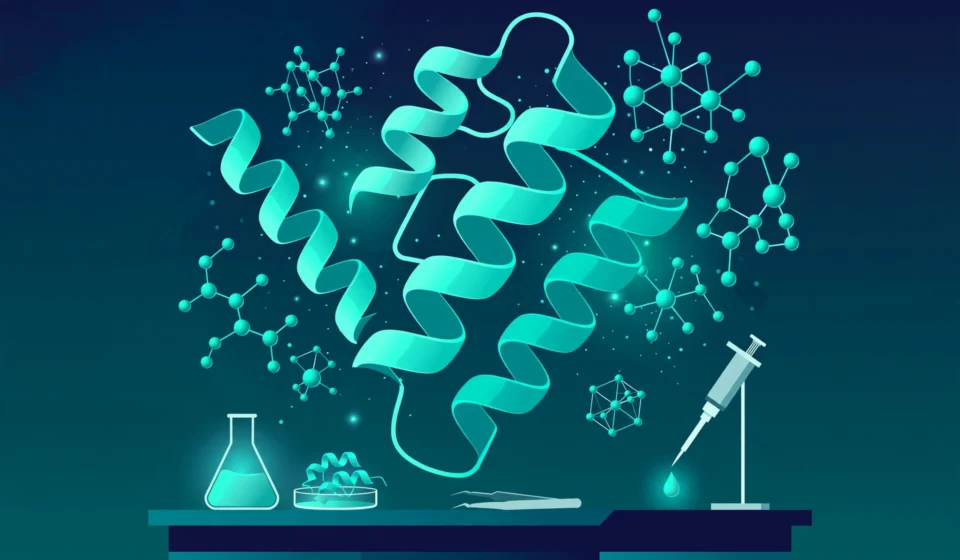

GPT-6 protein design moved from benchmark charts into the wet lab on November 24, 2026, when OpenAI published a preprint showing that its GPT-6 family of models can design new protein structures and sequences using only reasoning and general-purpose code. Working with research partner Onava, the team synthesized 322 small proteins based on GPT-6.2 designs and tested whether they would bind to five human protein targets. Thirty-five of them did — a 10.9% hit rate that OpenAI presents as the first wet-lab evidence that a general-purpose language model can do meaningful protein-design work without a specialized biology model generating the designs.
The result matters because protein design has long belonged to specialist software. Tools such as RFdiffusion and ProteinMPNN were built for one job, and chaining them into a pipeline demands real expertise. OpenAI’s claim is that a single general model can now handle several stages of that workflow from plain-language prompts — specifying where a protein should attach, what shape it should take, and how many coils or strands it should contain — and write the code to explore the options.
The lab results do not prove that claim in full, but they move it from a benchmark argument to a physical one: molecules designed by a chatbot’s successor were made in a lab, and some of them stuck to their targets.
Table of Contents
How GPT-6 Protein Design Works in the Lab
The workflow starts with a prompt, not a biology-specific tool. Researchers gave GPT-6.2 the three-dimensional structure of a target protein and marked the spot where a small binding protein, called a minibinder, should attach. The model reasoned about how the two proteins might interact, then wrote and executed code to search for three-dimensional shapes that could fit. In one example OpenAI describes, the model designed a minibinder for IL-7Rα, a protein involved in immune signaling, by arranging five coiled sections into a shape that could grip the target’s surface. An internal model followed shape instructions — the number of coils or strands, the overall fold — with near-perfect fidelity in its designs.
Turning a shape into a testable molecule still needed help. GPT-6.2 designed the backbones, but SolubleMPNN supplied the amino-acid sequences that would fold into those shapes, and Boltz-2, OpenDDE and ESMFold2 filtered the candidates before anything reached the bench. OpenAI is open about this: the campaign was a hybrid pipeline, not a model working alone end to end. The 10.9% hit rate therefore measures a combined system, with GPT-6.2 responsible for the creative step of inventing the shapes.
The headline experiment tested 322 minibinders against five medically relevant targets. PD-L1 is a protein some cancers use to hide from the immune system; VEGF-A drives blood-vessel growth and is a target in cancer and eye disease; IL-17A is involved in inflammation. The hits were uneven: 18 binders for IL-17A, eight for VEGF-A, five for PD-L1, three for IL-7Rα and just one for TrkA. OpenAI notes the original RFdiffusion study reported higher hit rates, while stressing that such numbers depend heavily on pre-filtering and on how binding success is defined.
A second set of experiments asked the model to write new amino-acid sequences for structures it had already designed or that already existed. Given three-dimensional models of confirmed minibinders with their original sequences hidden, GPT-6.2 proposed replacements that bound their targets in 75 of 88 designs for MDM2 (85%), 26 of 42 for VEGF-A (62%) and 8 of 59 for PD-1 (14%).
The model also redesigned the binding loops of small antibodies: 128 of 182 redesigned VHH antibodies (70%) kept binding to IL-4Rα, and 179 of 272 fragments from five therapeutic antibodies (66%) kept binding to PD-1 or PD-L1.
By the Numbers
| Test | What was measured | Result |
|---|---|---|
| New minibinders | 322 designs against 5 targets | 35 bound (10.9%) |
| Best target | Binders for IL-17A | 18 of 35 hits |
| Sequence redesign, MDM2 | 88 designs | 75 bound (85%) |
| Antibody loop redesign | 182 VHH designs | 128 bound (70%) |
| Small-molecule docking | PoseBusters, GPT-6.2 vs DiffDock-L | 93% vs 50% |
| Full structure prediction | TM-score, latest internal model vs ESMFold2 | 0.38 vs 0.93 |
What the Results Do and Do Not Prove
The strongest reading of the preprint is narrow and honest: a general-purpose model can now generate protein backbones good enough that, once sequences are assigned and candidates filtered by specialist tools, roughly one in nine designs binds its target in the lab. That is a genuine capability, and it arrives with a clear division of labor.
OpenAI’s own limitations section states that the results do not yet establish that its models can generate new minibinders end to end, in a zero-shot setting, without help from specialized models. On 14 protein tasks, the latest internal model matched or beat specialists on most — but full structure prediction remains a clear weakness.
The gap is large: the latest internal model averaged a TM-score of 0.38 on structure prediction, against 0.93 for the specialist ESMFold2. Some scores may also partly reflect memorization, OpenAI says, because the test structures were public and may have appeared in training data. And binding in an assay is not biological function: the preprint publishes no data on affinity, potency, toxicity or stability, and nothing shows a designed protein altering a disease process.
“Predicting a complete protein structure from its amino acid sequence remains substantially harder for our models than several of the component tasks above.”
— OpenAI, GPT-6 models demonstrate intrinsic protein-design capabilities
What GPT-6 Protein Design Could Mean for Drug Discovery
If the trajectory holds, the practical prize is speed. Drug discovery cycles through designing candidates, making them, testing them and starting over; OpenAI’s stated goal is to shorten each round and cut the total number of cycles needed. A researcher who can describe a target in plain language and get back testable candidates — without assembling a chain of specialist tools — could iterate far faster, particularly on early-stage ideas that today never justify the setup cost.
Our earlier coverage of the model family, GPT-6.2 Astra: OpenAI’s Faster, Cheaper Frontier (2026), covers the model behind these designs.
Realism is still warranted. A 10.9% hit rate is a research result, not a pipeline, and the path from a binder in a dish to a medicine runs through specificity, stability, manufacturability, animal studies and clinical trials — none of which this preprint addresses. OpenAI itself frames the next steps as finding binders for harder targets, testing whether designed molecules produce a real biological effect such as killing a cancer cell, and widening the range of molecules to RNA, multi-target binders and small molecules. The same week also brought a very different OpenAI release: OpenAI Shirudo, a Linux security runtime built with Cisco, showing how broad the lab’s current shipping cadence has become.
Biosecurity and the Road Ahead
Protein design is dual-use science: the same capability that helps design medicines could be misused, and OpenAI addresses that directly. The company says its Preparedness Framework guides how it assesses biosecurity risks and tests safeguards, and the release included a risk-card addendum and SynthID Bio watermarking for designed sequences. Practical limits also gate the capability for now — the hybrid pipeline, the structure-prediction gap and the cost of wet-lab validation slow misuse as much as use.
Frequently Asked Questions
Is GPT-6 designing real drugs now?
No. The preprint shows designed proteins binding to targets in lab assays — an early step. It establishes no therapeutic effect, safety or performance in living organisms, and the findings have not been peer-reviewed.
Did GPT-6.2 work alone?
No. It designed the backbones and, in the second experiment, new sequences. Specialist models supplied sequences for the first campaign, filtered candidates and predicted structures. OpenAI states the results do not establish end-to-end design without specialist help.
What is a minibinder?
A small, engineered protein designed to attach to a chosen spot on a larger target protein — here, targets linked to cancer and inflammation. Minibinders are research tools and potential starting points for future drugs, not medicines themselves.
Verdict
GPT-6 protein design is a measured step toward programmable molecular design, not a breakthrough drug pipeline. The 10.9% wet-lab hit rate is real evidence that general-purpose models can contribute to protein engineering — but the hybrid pipeline, the structure-prediction gap and the long road from binding to medicine all argue for patience. Watch the next preprint: if the TM-score gap closes, the story changes completely.
Sources