

The Tidal AI music ban begins on December 9, 2026, when the streaming service will start removing every track it determines was generated entirely by artificial intelligence. Tidal says the purge will delete around 29 million songs by the beginning of 2027, and that it will go on rejecting an estimated 80,000 to 85,000 fully AI-generated submissions every single day after that. It is the first time a major streaming platform has moved from labeling AI music to deleting it outright.
The scale of the problem explains the severity of the response. Tidal says 43% of all tracks distributed to it over the past 90 days were detected as wholly AI-generated, and on November 6 alone the figure hit 60%. The flood is the direct result of how cheap generation has become: AI music tools can now produce a finished-sounding song in minutes, and distributors have been uploading them by the tens of thousands, chasing fractions of a cent per stream. For human artists, the result is a catalog where their work is buried under an avalanche of machine-made songs that almost nobody plays — and a royalty pool diluted by tracks that cost nothing to make.

Table of Contents
How the Tidal AI Music Ban Works
The policy is simple in structure and strict in execution. Starting December 9, any track submitted to Tidal that is wholly AI-generated will be rejected and removed, and distributors will be banned from delivering such tracks at all. Tidal will refuse a delivery when the metadata says the recording was generated solely with AI tools, and its own detection systems will flag the rest. The company has named Ircam Amplify, the commercial arm of the French audio research institute IRCAM, as the technology partner behind its detection. Existing tracks already on the service are not exempt: the removal covers the back catalog, so songs already sitting in subscribers’ libraries will disappear over the course of December.
The line Tidal draws is between wholly generated and AI-assisted. Tracks that were assisted by AI tools but are not the sole output of those tools will still be allowed on the platform — a human artist using AI for a beat, a vocal effect or a mix is unaffected. That distinction is the hardest part of the policy to enforce, and it is where the detection technology earns its keep. Tidal’s position, stated in its announcement, is that the ban exists so the service remains the best place for artists to share their work and for listeners to enjoy it — a framing that puts human creators, not the technology, at the center of the decision.
By the Numbers
| Figure | Number | What it means |
|---|---|---|
| Tracks to be deleted | ~29 million | Gone by the start of 2027 |
| Daily rejections after Dec 9 | 80,000–85,000 songs | Every day, indefinitely |
| Share of recent submissions detected as fully AI-made | 43% | Over the past 90 days |
| Peak single-day share | 60% | November 6, 2026 |
| Previous policy (June 2026) | Labeling + no royalties | Now escalated to removal |
From Labels to Deletion: Why Now
This is not Tidal’s first move against synthetic music. In June 2026 the service began tagging wholly AI-generated tracks in its app and blocking them from earning royalties — a softer approach that treated the problem as one of disclosure and payment. Five months later, the company has concluded that labeling was not enough.
The numbers support that reading: if 43% of incoming tracks are machine-made, a catalog that simply labels them still drowns human artists in noise, and a royalty block still leaves discovery clogged. Deletion is the escalation Tidal chose. The service, owned by Block, is betting that listeners and artists will reward a cleaner catalog — and that being first to draw the line is worth the argument over where exactly it falls.
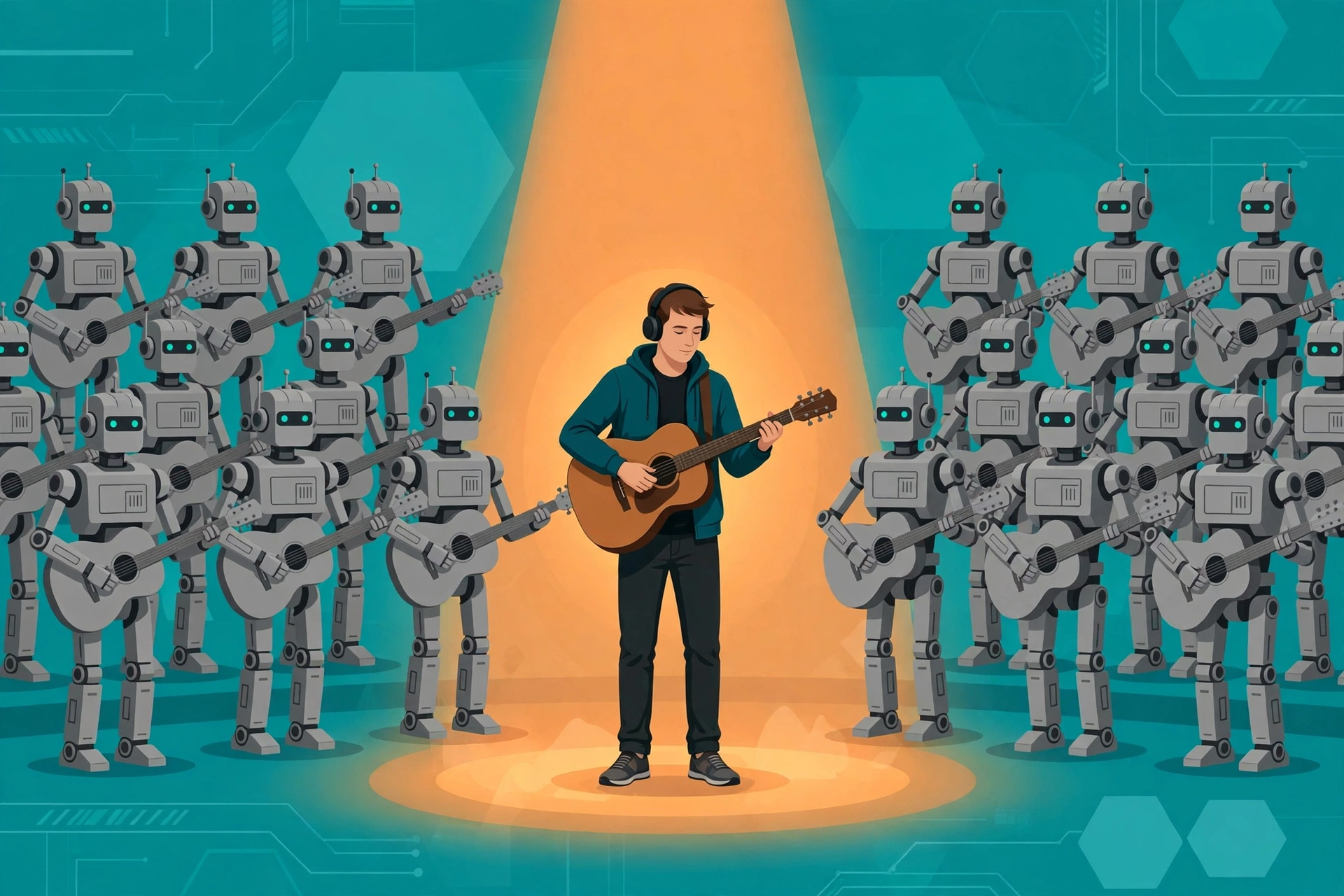
“To ensure Tidal remains the best place for artists to share their work, and for listeners to enjoy it, we’re removing all tracks that we determine are 100% AI generated. We’re also banning distributors from delivering these tracks to us, and will reject deliveries if their metadata says they were generated solely using AI tools. Tracks that were assisted by AI tools, but not the sole outputs, will be allowed on the platform.”
— Tidal, November 24, 2026, via TechCrunch
What the Tidal AI Music Ban Means for Artists
For working musicians, the immediate effect is a catalog that gets noticeably smaller and, Tidal argues, fairer. Royalty pools on streaming services are divided by share of plays, so tens of millions of machine-made tracks dilute what human artists earn even when those tracks are barely played. Removing them does not fix streaming economics — per-stream rates remain tiny — but it removes a class of competitor that has no costs, no career and no audience to serve.
The risk for artists is the gray zone: a track that leans heavily on AI assistance could be flagged wrongly, and an appeals process has not been detailed publicly. For now, the safest reading is that fully human-made work is unaffected, lightly assisted work is allowed, and only work with no human creative input is targeted.
For the wider industry, Tidal’s move is a test case the bigger services will watch closely. Spotify and Apple Music have so far leaned on disclosure and demonetization rather than removal, and a successful purge — measured in artist sentiment, subscriber reaction and catalog quality — could pull them in the same direction. If the purge goes wrong, through false positives or a catalog that feels emptier without sounding better, it will be cited as the reason not to try.
Either way, November 24, 2026 is likely to be remembered as the day the streaming industry stopped treating AI slop as a labeling problem and started treating it as a catalog problem. Our guide to Best AI Music Generators in 2026 covers the tools behind the flood — and the legitimate creative uses that the new policy deliberately leaves alone.
What to Watch Next
Three things will decide whether the ban works. First, detection accuracy: Ircam Amplify’s systems must separate wholly generated tracks from assisted ones at a scale of tens of thousands of decisions a day, and errors will be public and embarrassing. Second, distributor behavior: banning delivery is only effective if distributors comply rather than routing the same tracks through new accounts. Third, the reaction of the other platforms: if Spotify follows, the economics of AI music farms collapse overnight; if it does not, Tidal’s catalog simply becomes the smaller one. December 9 is the first checkpoint — the day the deletions begin and the numbers stop being projections.
Frequently Asked Questions
Will songs I already saved disappear?
Possibly, if they are fully AI-generated. Tidal says the removal covers its whole catalog, and tracks already in subscribers’ libraries will be removed as the purge runs through December.
Can artists still use AI tools?
Yes. The ban covers only tracks generated entirely by AI. Music assisted by AI tools — a human artist using AI for part of the production — remains allowed.
Why 29 million tracks?
That is Tidal’s own estimate of the wholly AI-generated tracks in its catalog, which it expects to delete by the beginning of 2027. The company says the purge will be followed by 80,000 to 85,000 rejected submissions a day.
Verdict
The Tidal AI music ban is the streaming industry’s first hard line against fully synthetic music, and its scale — 29 million tracks, 80,000 rejections a day — shows how far the flood had already gone. Whether it reads as brave or reckless will depend on detection accuracy and on whether bigger rivals follow. For human artists, though, the signal is unmistakable: at least one platform has decided their work is worth protecting with deletion, not just a label.
Sources