
If you are building a voice agent that has to answer in real time, every millisecond matters. A half-second pause makes a phone bot feel broken, and that is exactly the problem Cartesia set out to solve. Cartesia is a real-time AI voice platform whose flagship text-to-speech model, Sonic, is built for live conversation rather than offline narration. In this Cartesia review, we look at what Sonic-3.6 can actually do, what it costs, and where it falls short — so you can decide whether it belongs in your voice stack.
Table of Contents
What Is Cartesia?
Cartesia is an AI voice company founded by researchers from Stanford, and its models are built on state-space model (SSM) architecture rather than the transformer architecture most competitors use. According to Cartesia, this design is what allows Sonic to generate speech with very low latency and high concurrency at production scale. The platform covers three products:
- Sonic — the text-to-speech model at the heart of Cartesia, currently in version Sonic-3.6.
- Ink — a streaming speech-to-text model (currently Ink-2) for transcription, with built-in turn detection for conversational agents.
- Line — a managed platform for building and running voice agents, combining Sonic and Ink with telephony and call handling.
Together, Sonic, Ink, and Line let a team run the full speech layer of a voice agent — listening, thinking, and speaking — from a single vendor and a single pool of credits. Cartesia also offers a best AI voice generators overview if you want to see how it stacks up against the wider field.
Key Features of Cartesia
1. Sub-90ms Latency for Real-Time Conversation
Cartesia advertises first audio in under 90 milliseconds for Sonic, with streaming support so playback can begin before the full response is generated. This is a vendor claim about model latency, not end-to-end call latency — in a real deployment, speech recognition, the language model, network conditions, and audio playback all add time on top. Still, independent third-party measurements have put Sonic’s real-world time-to-first-audio in roughly the 100–190ms range, which remains among the fastest available. For phone agents and live assistants, that speed is the product’s defining advantage.
2. Sonic-3.6: Natural, Expressive Speech
Sonic-3.6 is Cartesia’s current text-to-speech model, generally available since August 2026 and fully backward-compatible with Sonic-3.5. It interprets the emotional subtext of a transcript automatically, so delivery adjusts to context without manual markup, and non-verbal expressions such as laughter can be inserted directly into the transcript (for example, “[laughter]”). Cartesia also reports higher accuracy on tricky pronunciations such as alphanumeric strings and heteronyms — the kind of detail that matters when a voice agent reads out order numbers or addresses. Sonic-3.6 also topped the independent Artificial Analysis speech leaderboards for naturalness in blind listener tests.
3. Voice Cloning: Instant and Professional
Cartesia offers two cloning tiers. Instant Voice Cloning creates a usable voice from a short reference sample — around 10 seconds of clean audio — and is available even on the free plan. Professional Voice Cloning uses 15–30 minutes of reference audio for the highest-fidelity clones in production, and is available on the Startup plan and above (Startup includes 2 professional clone slots, Scale includes 4). All clones require verified consent from the speaker, and cloning voices without permission is prohibited under Cartesia’s terms. Cloned voices work across Sonic text-to-speech, the API, and managed agents.
4. 44 Languages and Voice Localization
Sonic-3.6 supports 44 languages across 61 locales, including Spanish, French, German, Japanese, Chinese, Korean, Arabic, Hindi, Portuguese, Russian, Turkish, Vietnamese, Thai, and Indonesian. A voice localization feature lets you carry a voice — its emotion, tone, and speaker identity — into another language at native-speaker quality, at a cost of 225 credits per added voice accent.
5. Custom Pronunciation Dictionaries
For product names, proper nouns, and domain terms that generic models mangle, Cartesia lets you specify exact pronunciations, including phonetic notation. This is a small feature with an outsized impact for brands and regulated industries where a mispronounced name sounds unprofessional.
6. Flexible Deployment and Enterprise Security
On enterprise contracts, Sonic-3.6 can be deployed on-premises inside your own data center (including air-gapped environments), in your own VPC on AWS, GCP, or Azure, or via OEM licensing for embedding directly into your product. Cartesia is SOC 2 Type II certified, HIPAA-eligible with business associate agreements available, and GDPR-compliant, with zero data retention available for enterprise customers on eligible services.
Cartesia Pricing and Plans
Cartesia uses a credit-based system. Sonic text-to-speech costs 1 credit per character (roughly 750–800 credits per minute of audio), while Ink-2 speech-to-text costs 3 credits per second of audio. Every plan also includes a prepaid dollar balance for voice agent usage, billed at $0.03 per minute for managed agent calls, plus $0.014 per minute when using a Cartesia-provided phone number. Unused credits roll over up to twice your monthly allowance. Paid plans can enable overages: $65 per 1 million credits on Pro, $45 on Startup, and $38 on Scale.
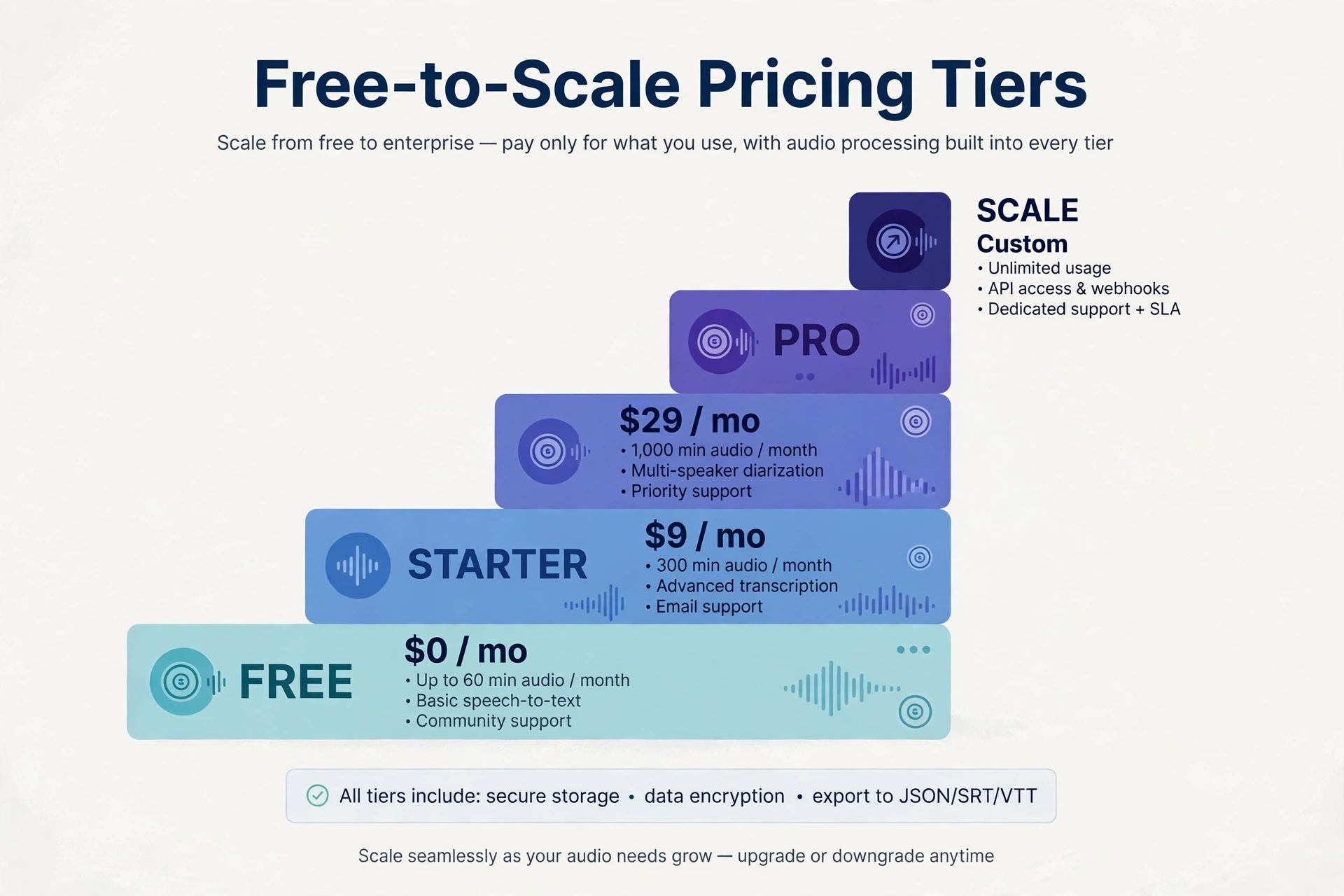
| Plan | Price | Model credits / month | Approx. Sonic minutes | Key extras |
|---|---|---|---|---|
| Free | $0 | 20,000 | ~27 | Instant voice cloning; no commercial-use license |
| Pro | $5/month | 100,000 | ~133 | Commercial-use license; instant voice cloning |
| Startup | $49/month | 1,250,000 | ~1,667 | Professional voice cloning (2 slots); organizations |
| Scale | $299/month | 8,000,000 | ~10,667 | Professional voice cloning (4 slots); priority support; 15 concurrent requests |
| Enterprise | Custom | Custom | Custom | On-prem/VPC/OEM deployment; SSO; zero data retention; custom SLAs |
The free plan is genuinely useful for evaluation — 20,000 credits plus instant voice cloning with no card required — but it carries no commercial-use license, so it is for prototyping, not shipping. The $5 Pro plan is the real entry point for production, and it is strikingly cheap next to rivals: at list prices, Cartesia’s Scale plan includes far more characters per dollar than the equivalent tier at ElevenLabs. Plans can be paused or cancelled at any time, and Cartesia also runs a startup grants program offering credits to qualifying early-stage companies.
Pros and Cons of Cartesia
Pros
- Best-in-class latency for live agents. Sub-90ms claimed time-to-first-audio, with streaming, makes Sonic the strongest pick when a voice agent must respond conversationally.
- Top-ranked naturalness. Sonic-3.6 leads the independent Artificial Analysis speech leaderboards, so speed does not come at the cost of robotic-sounding output.
- Generous free tier and cheap entry plan. 20,000 free credits with instant cloning, and commercial use from just $5/month.
- Full speech stack in one place. TTS, STT, and managed voice agents share one credit pool and one API key.
- Serious enterprise options. On-prem, VPC, and air-gapped deployment plus SOC 2, HIPAA-eligibility, and GDPR compliance.
- Transparent, rollover-friendly billing. Unused credits roll over up to 2x the monthly allowance on paid plans.
Cons
- Developer-first, not creator-first. Cartesia is an API platform. If you want a polished studio for recording audiobooks or YouTube narration, tools like Murf AI or ElevenLabs offer a friendlier workflow.
- Cloning fidelity is not the best on the market. In a September 2026 third-party voice-replication benchmark, Sonic-3.6 scored highly for naturalness but trailed rivals on speaker identity — so a clone may sound human but slightly less like the original speaker.
- No commercial license on the free plan. You must upgrade to Pro before using generated audio commercially.
- Credit math takes getting used to. Billing in credits per character, plus separate agent minutes and telephony charges, makes cost forecasting less obvious than a simple per-minute price.
- Vendor latency claims are model-side. Real end-to-end call latency depends on your STT, LLM, network, and playback chain, so the sub-90ms headline will not be what your callers experience in full.
Who Is Cartesia Best For?
Cartesia is best for developers and teams building real-time voice products: phone agents, customer-support bots, live in-app assistants, and conversational AI platforms where response speed decides whether the product feels alive. It is also a strong fit for enterprises in regulated industries that need on-prem or VPC deployment and compliance certifications. It is less ideal for solo creators who mainly need narration or dubbing for videos — for that, a creator-focused studio will be faster to use day to day.
Cartesia vs ElevenLabs: A Quick Comparison Note
ElevenLabs remains the broader, more creator-friendly platform, with a large voice library, a polished studio, and strong long-form narration tooling, while Cartesia is narrower and faster, purpose-built for live conversation where time-to-first-audio matters most. At list prices Cartesia also delivers more characters per dollar at comparable tiers, but ElevenLabs wins on ease of use for non-developers. If your priority is a real-time agent, choose Cartesia; if it is content creation and narration, ElevenLabs is the safer default. Our full ElevenLabs review covers that side of the comparison in detail.
Frequently Asked Questions
Is Cartesia free?
Yes. Cartesia has a free plan with 20,000 model credits per month (about 27 minutes of Sonic speech) plus $1 of prepaid voice-agent usage and instant voice cloning. It does not include a commercial-use license, so commercial projects need the $5/month Pro plan or higher.
How fast is Cartesia’s Sonic model?
Cartesia claims first audio in under 90 milliseconds for Sonic-3.6, with streaming so playback starts before the full response is generated. Independent measurements have put real-world time-to-first-audio roughly in the 100–190ms range, still among the fastest text-to-speech models available.
Can Cartesia clone my voice?
Yes. Instant Voice Cloning works from around 10 seconds of clean audio and is available even on the free plan. Professional Voice Cloning uses 15–30 minutes of reference audio and unlocks on the Startup plan and above. All clones require verified consent from the speaker.
How many languages does Cartesia support?
Sonic-3.6 supports 44 languages across 61 locales, and voice localization can carry a single voice into another language while preserving emotion, tone, and speaker identity.
Is Cartesia better than ElevenLabs?
It depends on the job. Cartesia leads on real-time latency and value per character, and tops independent naturalness benchmarks. ElevenLabs leads on creator tooling, voice library depth, and long-form narration workflows. For live voice agents, Cartesia is the stronger pick; for content creation, ElevenLabs usually is.
Verdict
Cartesia is the fastest serious AI voice platform you can buy in 2026, and unusually, it does not trade quality for that speed — Sonic-3.6’s top ranking on independent blind-listening benchmarks backs up the marketing. Its pricing is also refreshingly accessible: a usable free tier and commercial use from $5 a month. The trade-offs are real but narrow: it is an API-first developer tool rather than a creator studio, and its voice clones, while natural-sounding, are not the most faithful to the original speaker. For anyone building a real-time voice agent, Cartesia is the first tool we would test. For pure narration, look elsewhere first.
Rating: 4.5 out of 5